

A freshly installed marble kitchen worktop, a quartz table, a porcelain stoneware floor: on most projects, sooner or later, the client calls. “There's a stain that won't come off”, “the marble has lost its shine where I put the lemon down”. Knowing how to recognise the problem and recommend the right solution makes the difference between a disappointed client and one who calls you back for the next project.
No surface is truly impervious
Marble, granite, natural stone, engineered stone, terrazzo, cement tiles, concrete, terracotta, porcelain stoneware and ceramics: all these surfaces can absorb substances or be attacked by acids and foot traffic. Clients are often offered porcelain stoneware or a synthetic material as a “worry-free” alternative to stone, but engineered quartz, composite stone and porcelain stoneware can also stain or lose their shine.
There is, however, an advantage worth explaining to the client: natural surfaces are also the easiest to restore. Marble can be repolished or honed; many synthetic materials, once their surface is damaged, cannot be ground or brought back to their original finish.


Stain or etching? The first question to ask
These are two different types of damage requiring opposite treatments. Using the wrong product not only fails to solve the problem, it can set it and make further attempts more difficult.
Etching: a substance has removed the polish. To the touch or against the light you can see a duller, rougher or slightly hollowed area.
Stains: three questions before you act
- What caused it?Wine, coffee, oil, rust, wax: each substance has its own stain remover. Identifying it straight away avoids making things worse.
- How long has it been there?The longer the substance stays in the material, the harder it is to remove: an oil stain more than a year old can rarely be fully recovered.
- Has anything already been tried?Unsuitable products often set the stain. You need to know what has already been used to decide how to proceed.
Note: oil or grease stains are easily confused with damp, because they darken the material in patches. Before talking about rising damp or water ingress, it is worth ruling out oil.
Solutions for stains
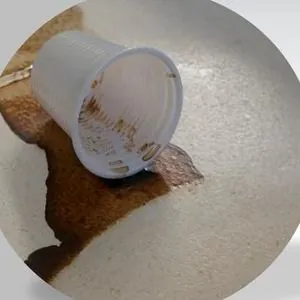 Wine, coffee, tea, nicotine, woodMGP 1 – Stain remover for coloured stainsDoes not damage surfaces and can be used even on the most delicate ones.
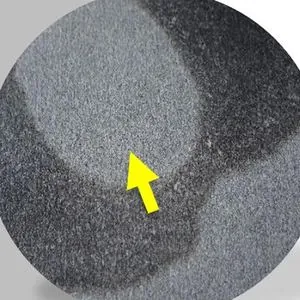 Oil, fat, wax, greaseMGP 2 – Stain remover for oil and grease stainsDraws grease out of the pores without attacking the material.
 RustCLEAN RUST / CLEAN RUST MARMOCLEAN RUST for stone and granite, CLEAN RUST MARMO also for polished marble.
 To hand over to the clientKIT SMACCHIATOREMGP 1, MGP 2 and MGP 25 in a carry case: everything you need to clean worktops and remove stains.

Etching: how deep is the damage?
Acidic substances (lemon, vinegar, wine, fizzy drinks, limescale removers) don't just remove the polish: sometimes they also leave a coloured mark, which must be treated as a stain. The first step is to identify the cause; the second is to assess the depth.
- Surface etchingA glass of champagne, a slice of lemon, a splash of soft drink: the damage is just a few microns deep and can be recovered chemically, without grinding.
- Deep or extensive etchingA limescale remover left to act, or very large areas, can lower the surface by a few tenths of a millimetre: in this case grinding is needed, taking the stone back to a rough finish to level out the differences and then to the desired finish.
- Dulling from foot trafficOn polished floors the loss of shine is gradual and concentrated in the walkways.
Solutions for etching
 Lemon, vinegar, acidic foodsMAGIC KIT – Etch mark restorationIn 3 steps it removes glass rings, scratches and localised dull spots, bringing marble back to its original shine.
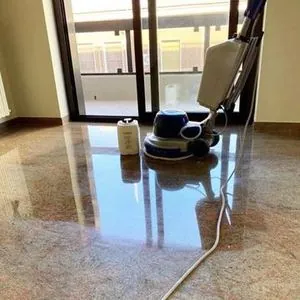 Shine lost to foot trafficCROCOSHINE – Floor polishRestores the shine of dulled polished marble, by hand with a microfibre cloth or with a single-disc machine and white pad.
 Small marks, tops and edgesCROCODILE WAX – Paste waxRevives colour and shine on vanity tops, tables, bullnose edges and dulled edges.

The real advice: prevent at the design stage
The best way to avoid that phone call is to include the treatment in the specification from the start. Specifying a protective product suited to the material and finish costs little compared with a restoration, and it protects both the project and your reputation.


· marble kitchen worktops and tables → SAFE MARBLE antiacid protection (polished, satin or matt);
· stone and granite → stain-repellent protector specific to the finish (rough, honed or polished);
· maintenance → a kit to hand over to the client together with the finished work.
In short
Every surface, natural or synthetic, can suffer from stains, dulling or etching. In most cases there is a solution, provided you recognise the damage and choose the right product. And natural surfaces, often considered more delicate, are precisely the ones that can always be restored.
Do you have a project with a problem to solve?
Send us a photo and a couple of lines about the material: our technical department will reply with the solution and, if needed, the technical data sheets for the specification.
Ask for technical adviceDownload the appIn the next guide for architects: ceramics and porcelain stoneware — shade variations between batches, surfaces that are too slippery, finishes that trap dirt, maintenance and grout joints.


